



A nonprofit founder is finishing her third grant proposal this month. She is also the website manager, the donor communications person, and the one who actually runs the programme. She has no budget for outside help. She has been told that using artificial intelligence (AI) is cutting corners. A well-funded organization in the same sector is using AI across every one of those functions and calling it operational excellence. The gap between them is not a values gap. It is a resources gap dressed up as a moral one.
TL;DR
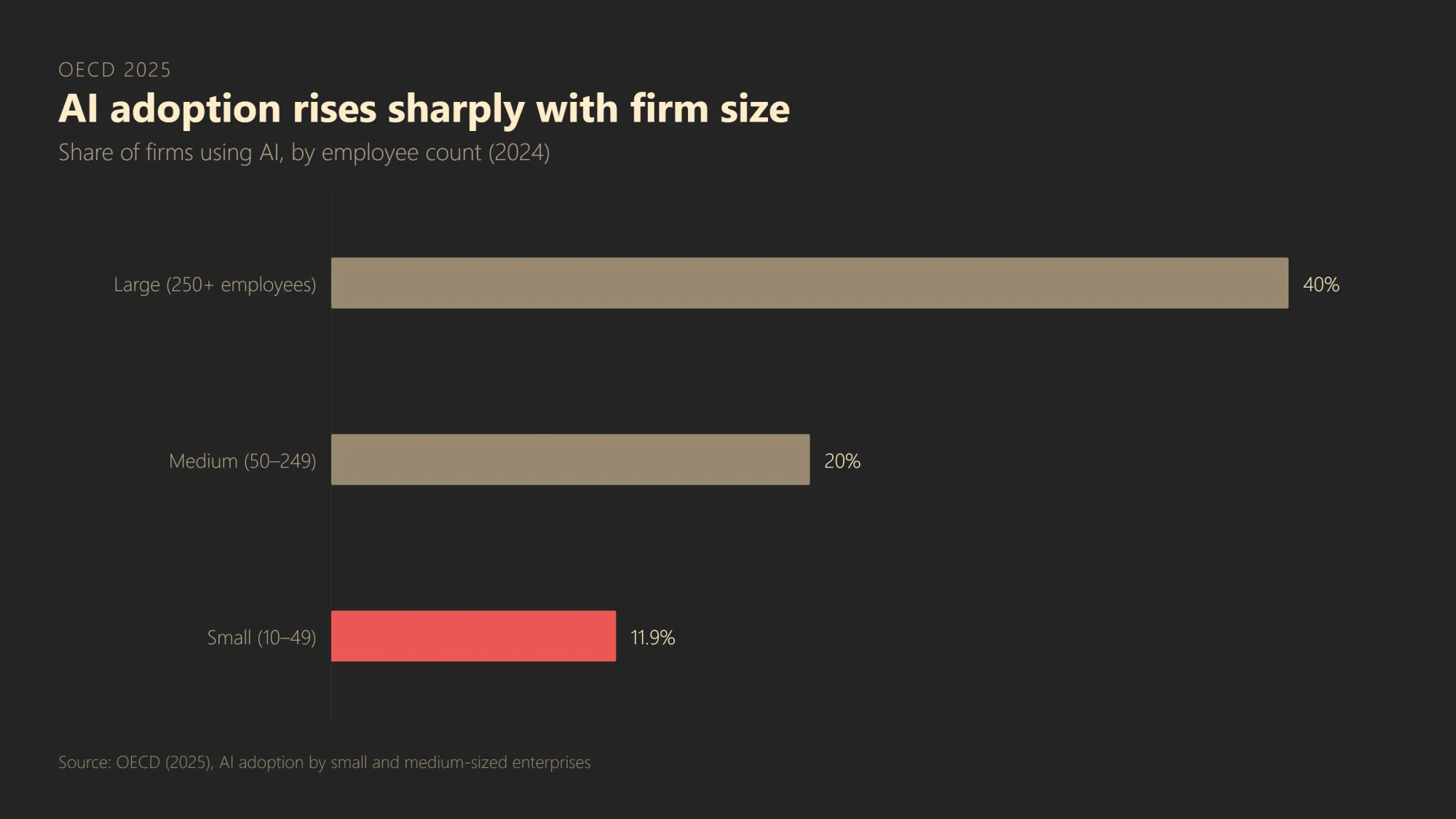
- Large firms adopt AI at more than three times the rate of small firms. The gap is structural, not ethical.
- 88% of organizations report regular AI use, but the headline flatters the reality for smaller businesses with fewer resources and no dedicated teams.
- 82% of small businesses using AI report efficiency gains; 77% report improved competitiveness against larger firms.
- Telling underfunded founders to hire specialists instead ignores what those roles actually cost relative to small-business revenue.
- The real risk is not AI adoption. It is adoption without criteria, data boundaries, or a clear internal policy on where human judgment is non-negotiable.
The privilege nobody names
Adrianna
The framing most people inherit treats AI adoption as a moral test. Businesses that use AI are cutting corners, displacing workers, accelerating something vaguely harmful. Businesses that refuse AI are principled, human-centered, authentic. This framing feels clean. It contains a structural assumption that rarely gets examined: that opting out is equally available to everyone.
It is not.
OECD (Organisation for Economic Co-operation and Development) research published in 2025 found that 40% of large firms with 250 or more employees were using AI in 2024. Among firms with 50 to 249 employees, that figure drops to 20%. Among small firms with 10 to 49 employees, it falls to 11.9%. That gap does not reflect stronger ethics. It reflects capital, technical staff, and the operational slack to run experiments that might not pay off for six months. Small businesses are often too stretched for that kind of patience.
McKinsey’s 2025 State of AI survey found 88% of organizations use AI regularly in at least one business function, up from 78% the year before. That headline sounds as if the debate is settled. What it obscures is that the 88% skews heavily toward larger, better-resourced organizations with existing infrastructure and dedicated teams. Widespread adoption does not mean equal adoption. Equal adoption would not mean equal returns.
Returns are more concentrated still. PwC’s 2026 AI Performance Study found that just 20% of organizations are capturing nearly three-quarters (74%) of AI’s measurable economic value. The winner-takes-most dynamic is already in place before most small businesses have run a single pilot. The firms gaining the most were already the best resourced.
There is also a double standard worth naming directly. When large companies adopt AI, it is called innovation and operational efficiency. When small businesses do the same, they are often told they are cutting corners or replacing real workers. The same behavior earns different verdicts depending on who is doing it. This asymmetry discourages the businesses that have the most practical reason to engage with AI carefully.
The useful question is not who is pure. It is who bears the cost when the answer is no.
What inefficiency actually costs
Daria
Here is what a real week looks like for a solo founder or small team without AI support. You write every email from scratch. You rebuild proposals by editing old files, usually missing something in the process. Research that takes an AI forty seconds takes you forty minutes, interrupted twice. Admin piles up. Content does not happen because by the time client work is done, there is nothing left.
That invisible work carries a real cost. Not just time. Cognitive load, the mental effort of holding every loose end in your head at once.
A founder spending three hours on tasks that could take thirty minutes is not three hours behind on admin. They are three hours behind on thinking, deciding, and building the thing that makes their business worth running. Small businesses cannot absorb this the way larger firms can. A company with thirty staff treats administrative waste as a line item. A two-person business treats it as a slow, compounding crisis.
There are three realistic paths for a small business that wants to operate without AI.
Stay fully manual and price at premium. Some craft businesses, therapy practices, and high-trust consultancies operate here profitably. It is a real model. But it requires pricing that reflects the true cost of manual labour. Most underfunded founders cannot yet command those rates, particularly early on.
Hire specialists to cover what AI would otherwise handle. That means a copywriter, developer, strategist, project manager, and analyst. Together, those roles cost more per month than most early-stage businesses turn over. “Just hire humans” is advice from a position of financial comfort. It does not reckon with the actual choices a small business faces between payroll, software, rent, and still somehow being visible in the market.
Use AI selectively, with a clear internal policy about where it belongs and where it does not. This is not a compromise. It is the path that gives a small business a realistic shot at staying viable without burning out the people running it.
JPMorgan Chase Institute research found that 82% of small businesses using AI report enhanced operational efficiency, and 77% report improved competitiveness against larger firms. That is not an argument for adopting every available tool. It is an argument for taking the question seriously.
The divide that actually matters
TTT
The real risk with AI in small business is not adoption. It is adoption without criteria.
Generic content that sounds like every other business in the category. Statistics published without review. Automation that undercuts client trust. Privacy shortcuts applied to data that should never have left the building. These failures are real and worth preventing. They are solved by having clear standards for where AI is used and how, not by refusing to engage with the question entirely.
There is a fifth failure mode this framing risks skipping over: environmental cost. Running large language models draws real electricity, at a scale that stopped being trivial a while ago. The IEA’s April 2026 report put global data centre electricity demand at roughly 485 terawatt-hours in 2025, on track to reach 950 terawatt-hours by 2030, with AI-driven demand as the fastest-growing share of that number. For a purpose-driven small business that has spent years building a low-carbon operation, treating a favourite AI tool as a free lunch is exactly the kind of adoption without criteria this piece is arguing against. The honest position is not to pretend that trade-off does not exist. It is to weigh it deliberately: use AI where the operational case is strong enough to justify the energy cost, favour providers who publish real efficiency data over vague offset claims, and stay sceptical of any tool that treats compute as free.
The divide that matters is not AI versus no AI. It is strategic AI versus chaotic AI. Chaotic AI produces more noise, faster. Strategic AI reduces waste, sharpens decisions, and keeps humans in the roles where their judgment actually counts.
For a small business, building that distinction starts with five questions:
- Where is time actually going, and which of those tasks require human judgment to do well?
- Which workflows create the most cognitive load for the people running them?
- Where would automation improve the client experience, and where would it erode it?
- What data should never enter a third-party tool, regardless of how convenient that tool is?
- Where is the current operation producing output that nobody actually needs?
Those questions matter more than any subscription. They are also the foundation of AI literacy, which is more useful to a small business than AI fluency. A business that understands what a tool consistently gets wrong, which outputs require mandatory human review before reaching a client, and what it should never handle is in a much stronger position than one with twelve subscriptions and no policy.
A small business that has done this well uses AI for the work that was never a good use of human attention: drafting, formatting, summarizing, preparing options for someone to evaluate, handling routine communication. It keeps humans in every decision requiring taste, accountability, or genuine care. The work gets faster. The standards do not drop. The founders are still standing in two years.
AI should not replace your values. For many small businesses, it may be one of the few tools that gives those values a fighting chance in a market where better-resourced competitors have already made their choice.
If you want to work out where AI actually belongs in your operation, start by mapping where your time is going. We run AI literacy sessions for small and purpose-driven businesses that want to adopt AI with judgment rather than pressure. Book a session, or email us your biggest operational time drain.
Frequently asked questions
Is it ethical for a small business to use AI?
Using AI is not inherently unethical, and avoiding it is not inherently ethical. A business can refuse all AI tools and still operate wasteful systems, use exploitative supply chains, or publish content that erodes trust. The relevant question is where AI reduces harm and waste in your specific operation, and where it creates risk. Responsible use means knowing where not to apply it as much as where to.
Can a small business realistically compete without AI tools?
It depends on the business model and the margin available to absorb inefficiency. Some premium craft businesses and high-trust consultancies operate successfully without AI. But for most small businesses without significant capital or staff, avoiding AI entirely means competing against better-resourced organizations while refusing one of the few tools that can narrow that gap. OECD data shows large firms adopt AI at more than three times the rate of small firms.
What tasks should always stay human, even when a business uses AI?
Final judgment on any client-facing output, decisions that carry accountability, relationships built on trust, ethical oversight, and any work where quality depends on genuine attention rather than pattern-matching. AI suits drafting, researching, summarizing, and preparing options for a human to evaluate. It is not suited for deciding which option is right, for building relationships that require real trust, or for anything where being wrong has consequences.
Is AI-free positioning becoming a premium model rather than a universal ethical standard?
In some sectors, yes. Businesses in craft, therapy, and high-trust consulting can position as fully human-made and charge accordingly. But AI-free work costs more to produce, and that cost must be covered somewhere. Not every small business can price at the level needed to sustain a fully manual operation against competitors using AI to reduce their own costs. It is a valid niche, not a viable default for most underfunded founders.