
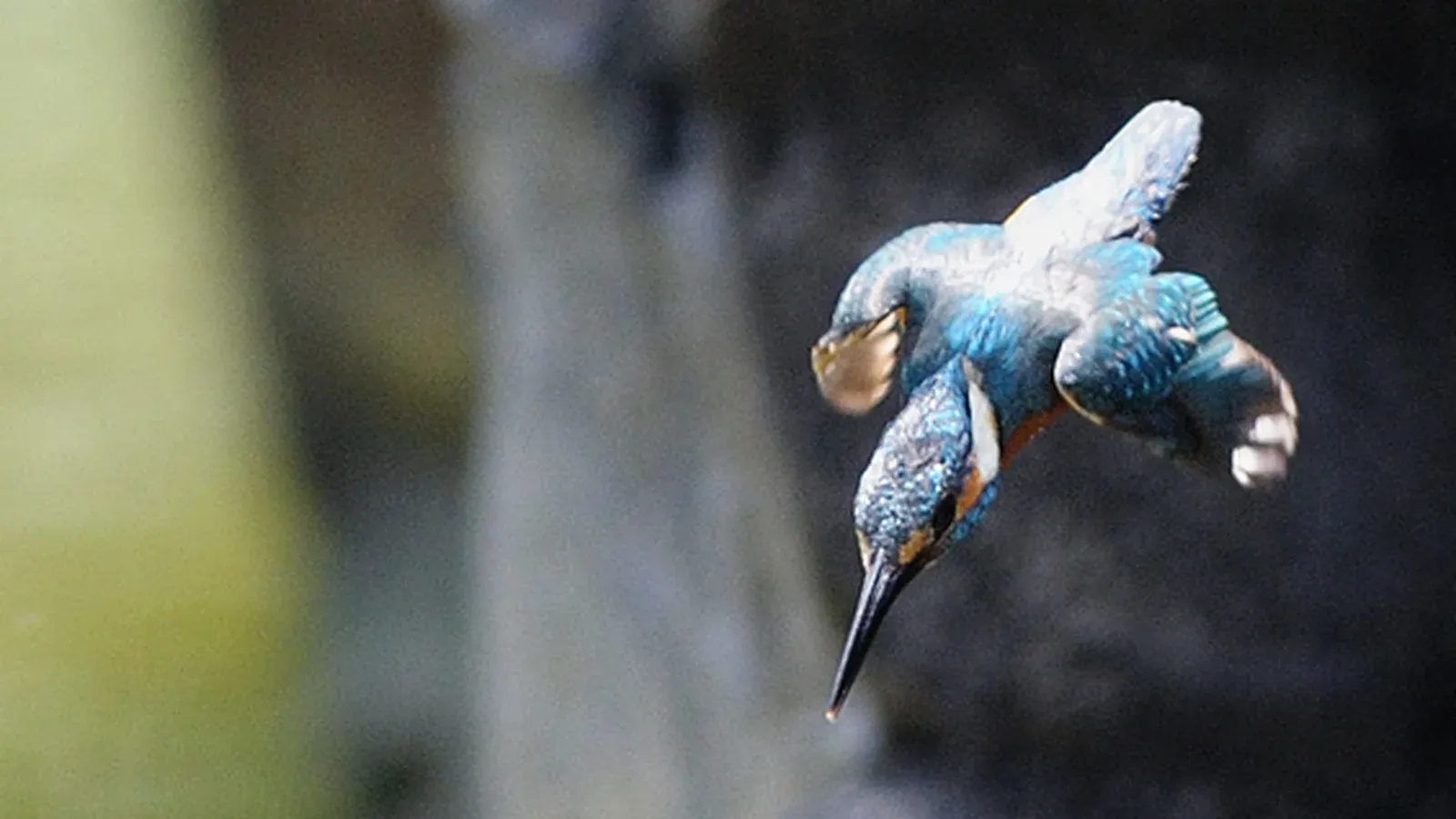
The pitch is everywhere once you start noticing it: a Japanese engineer watched a kingfisher dive into a pond, copied the beak, and solved his train’s noise problem in one flash of insight. I kept meeting that version while researching sustainable design. In my day job doing clinical research, a figure without a source document does not count, no matter how good it sounds. I pointed that same rule at biomimicry’s most famous story and went looking for what actually happened.
TL;DR
- The kingfisher story is true, but it is one of three animals, not one. The owl solved a second noise source; a penguin shaped a support strut.
- The brief was noise reduction, not speed. Japan caps trackside train noise at 70 decibels, and that limit drove the whole redesign.
- The “flash of insight” was a conference lecture on bird-inspired aviation design, followed by four years of wind-tunnel and supercomputer testing.
- Nakatsu’s own figures: about 30% less air pressure, 15% less electricity, 10% higher speed. Independent retellings blur these into looser, less accurate numbers.
- The test worth keeping: ask what problem a “nature-inspired” design solved, what was measured, and who checked.
The version you have heard
In the 1990s, Japan’s high-speed trains had a problem. They were fast, but every time one shot out of a tunnel it produced a loud boom, loud enough to draw complaints from people living hundreds of metres away. An engineer named Eiji Nakatsu, who happened to love birdwatching, watched a kingfisher dive and realised the bird’s beak was the answer. He reshaped the front of the train to match it. The boom went away, and the train got faster and used less power as a bonus.
Every claim in that paragraph points at something real. Almost every emphasis in it is off.
What actually happened
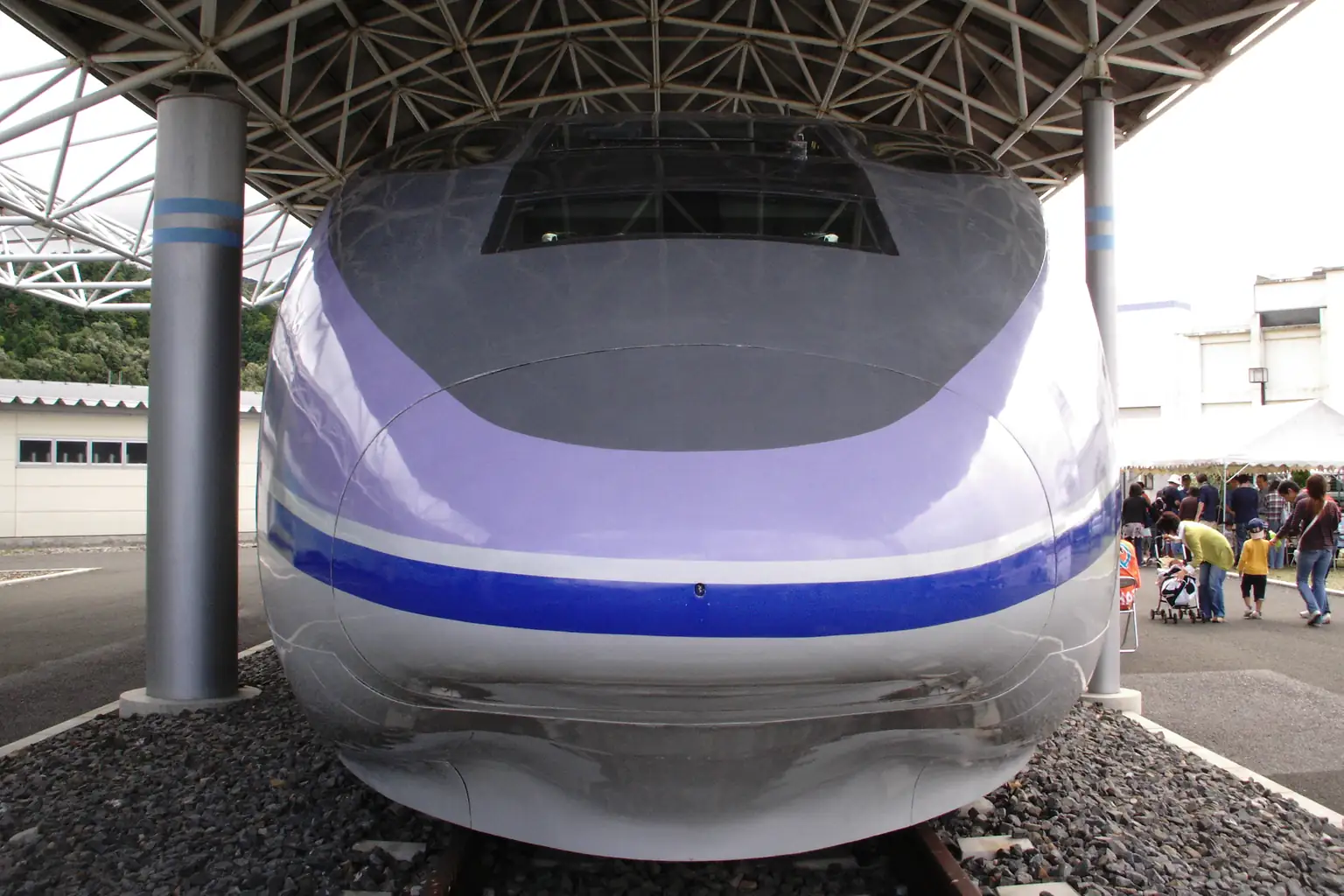
Start with the problem, because that is where the myth first bends. The brief was not “make it faster.” Nakatsu has said plainly that speed was the easy part; the hard part was noise, held to one of the strictest limits in the world (Japan’s environmental standard caps trackside noise at 70 dB in residential zones and 75 dB in commercial zones). The whole redesign was a fight against sound.
Then there is the number of birds. Not one. Three.
The tunnel boom was only one of two noise problems, and the kingfisher solved only that one. The bird dives from air into water, a fluid roughly 800 times denser, and slides in almost without a splash because of the long, tapered wedge of its beak. A train punching into the still air inside a tunnel faces a version of the same physics, so the front car became a 15-metre beak-like cone.
But the train had a second scream, from the pantograph, the hinged arm on the roof that draws power from the overhead wire. At speed, air tearing past that arm broke into a churn of small vortices called a Karman vortex street, and that churn was loud. To quiet it, Nakatsu’s team looked at the owl, one of the quietest hunters in the sky: its leading wing feathers carry a comb of tiny serrations that shred airflow into micro-turbulence before it can build into sound. Engineers cut matching serrations into the pantograph. A third bird, the Adelie penguin, lent its smooth spindle body to the strut that holds the pantograph up, cutting drag. Kingfisher for the nose, owl for the noise, penguin for the strut. The single-bird version deletes two thirds of the actual engineering.
The moment of inspiration was a lecture, not a walk
The popular story is a lone genius struck by sudden insight at a pond. The real account is less romantic and more useful. Nakatsu credited the owl idea to a lecture by an aircraft engineer, Seiichi Yajima, who was also a member of the Wild Bird Society, on how much aviation already borrowed from birds. The insight arrived in a conference room, from someone else’s reading.
It did not resolve in an afternoon either. The pantograph work alone took four years. The team borrowed a stuffed owl from a zoo in Osaka and put it in a wind tunnel next to a stuffed turtledove to measure which was quieter, then tested scale models and full-size prototypes. For the nose, they fired projectiles of different shapes into a pipe and ran simulations on a supercomputer built for space research. The kingfisher beak won that contest against every other shape tried. It was the shape that survived the testing, not a hunch that happened to work.
The numbers, with the caveat
Nakatsu’s own account gives three figures for the 500-series that entered service in March 1997: around 30% less air pressure, about 15% less electricity, and roughly 10% higher speed than the train it replaced. I am treating those as the anchor because they come closest to the source.
Watch what happens as the story travels, though. One retelling says “30% less air resistance.” Another folds the saving into “energy.” A separately reported measured run at 270 km/h put the power saving at about 13% against the older series, close to 15% but not identical. None of this makes the achievement smaller. It makes the point that even a well-documented success gets fuzzy in transmission, and that fuzziness is worth naming rather than smoothing over.
The objection worth taking seriously
If supercomputer testing had already identified the ideal nose shape, did the kingfisher actually teach anyone anything, or did the bird just happen to match a solution physics would have reached anyway?
The honest answer: the bird was a shortcut, not a revelation. Evolution had already run millions of years of testing on entering a dense fluid cleanly, and the kingfisher is one of its passing results. Nakatsu did not extract a law of physics the engineers lacked. He used a living creature as a very good first guess, then confirmed it the slow way, with models and data. That is a more modest claim than “nature solved our problem,” and a more useful one: it tells you what biomimicry is good for. Not magic. A shortlist of forms already stress-tested by survival, which you still have to verify yourself.
Why this matters past the train
Once you have seen how much a true story loses in the retelling, “nature-inspired” claims read differently. Most of them are not doing what Nakatsu did. They borrow the prestige of the kingfisher without any of the wind tunnels, the four years, or a number you can check.
The Shinkansen earns the label because there is a measured result underneath it and a documented process behind it: a boom that dropped below a legal limit, a power figure recorded on a real run, a four-year paper trail. Strip those away and you are left with a nice image of a bird, which is exactly what most “inspired by nature” marketing is: the image without the receipt.
If you have a nature-inspired design story you have always taken on faith, send it to daria@thetrinitytribe.com. It goes on the list for this series.
Frequently asked questions
Did a kingfisher really inspire Japan’s bullet train design?
Yes. Engineer Eiji Nakatsu reshaped the Shinkansen’s nose into a long, beak-like cone modelled on the kingfisher, specifically to reduce the sonic boom the train produced exiting tunnels. That part of the popular story is accurate.
Is the kingfisher the only animal involved?
No. An owl’s wing-feather serrations inspired the pantograph’s noise-reducing design, and a penguin’s body shape inspired the strut that supports it. Three animals solved three separate engineering problems.
How much did the redesign actually improve the train?
Nakatsu’s own figures for the 500-series Shinkansen: about 30% less air pressure, 15% less electricity use, and 10% higher speed than the train it replaced. Later measured runs report slightly different power savings (around 13%), which is normal variance between test conditions.