
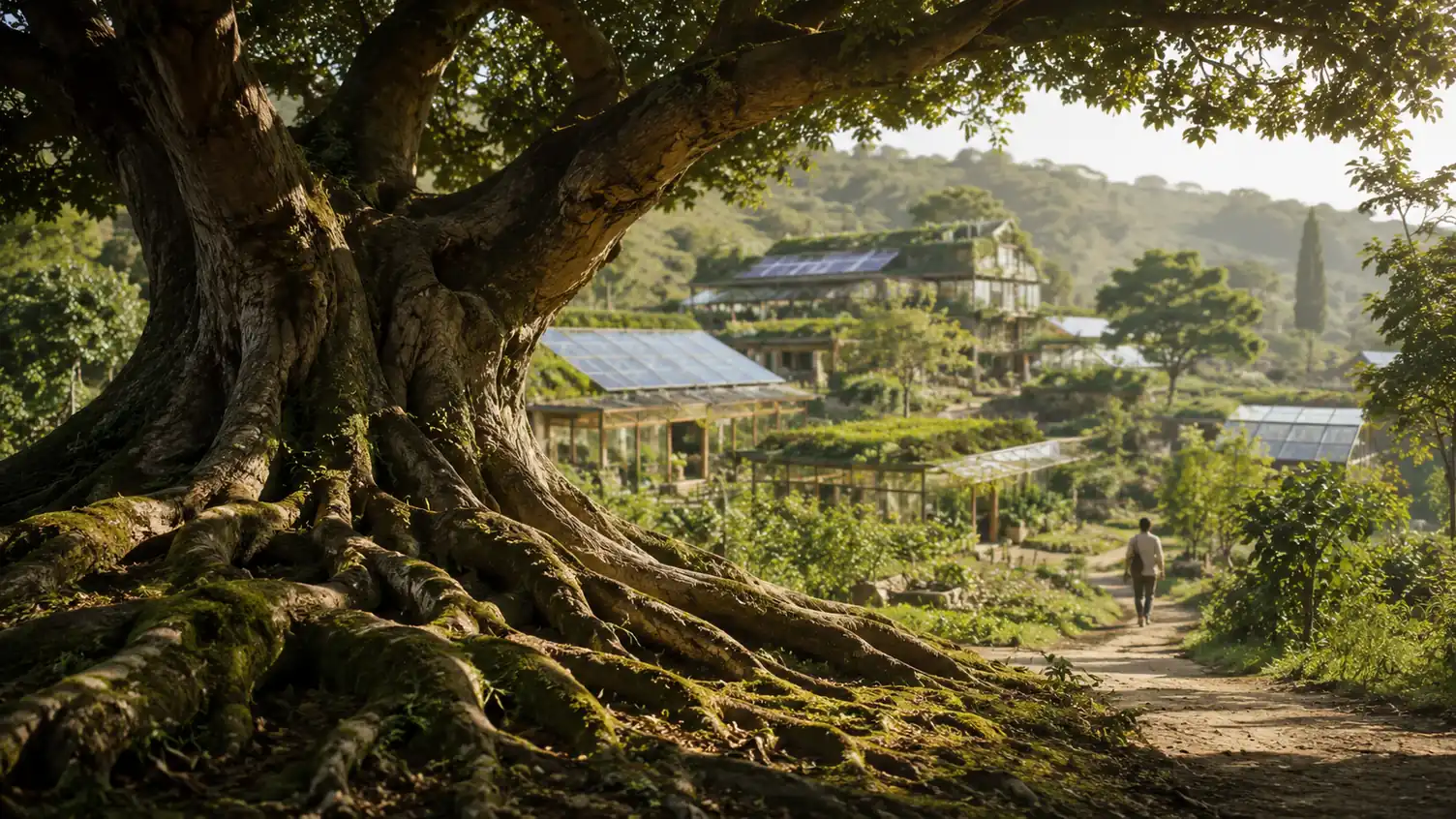
Solarpunk is most often described as a visual aesthetic: soft yellow afternoons, vertical gardens, art-nouveau curves wrapped around clean technology. The look is real, and it is having a moment. But solarpunk is also a movement and a philosophy, and the visual is the surface of a much older idea. The idea is this: technology and nature do not have to be in opposition. They can be designed to work together.
TL;DR
- Solarpunk is not an aesthetic. It is a design philosophy with roots in permaculture, social ecology, and systems science.
- “Green” means do less harm. “Sustainable” means hold the line. “Regenerative” means leave the system healthier.
- The word was coined in a 2008 blog post, took its look on Tumblr around 2014, and got its first anthology in 2017.
- A solarpunk practice is about more than carbon. It asks who owns the data, who controls the platform, and who maintains it later.
- At The Trinity Tribe this is concrete: we design for independence, build to last five to ten years, and decline extractive work.
That belief is why we use the word at The Trinity Tribe (TTT). Not because of the aesthetic. Because the philosophy gives us a way to think about digital products that “sustainable” no longer does.
Why the word matters
“Sustainable” has been worked to death. So has “green.” Most agencies that use these labels mean the same handful of things: we recycle the printer paper, we offset the flights, we put a leaf icon on the homepage. The terminology has been emptied of meaning, and the original ideas inside it have leaked out.
Solarpunk could go the same way. The aesthetic is easy to copy. You can already see the word attached to any product that is vaguely future-positive and has a plant in the mood board. If that becomes all it means, the politics and the design philosophy underneath will quietly disappear, and we will be back to looking for the next word.
So this article is a small attempt at protection: a written-down version of what the word actually means, so that we (and anyone reading) can remember.
Where solarpunk comes from
Solarpunk is older than its 2010s breakthrough. Its intellectual roots run through four distinct currents. Each of them is worth more than the short summary we can give it here. For now, the headline version of each:
Permaculture. In the mid-1970s, Bill Mollison and David Holmgren co-developed a design framework based on observing how natural systems already work. The twelve principles most people quote (observe before you act, produce no waste, use small slow solutions, value the marginal) came later: Holmgren set them out in 2002, in Permaculture: Principles and Pathways Beyond Sustainability. They treat nature as a methodology, not a metaphor, and they travel well from agriculture into digital design.
Social ecology. Murray Bookchin spent the 1960s through the 1990s arguing that ecological crisis is not, fundamentally, a technological problem. It is a social one. The way we organize work, ownership, and authority shapes what the technology can even be. A truly solarpunk practice is not only about reducing carbon. It is about who owns the data, who controls the platform, and who can maintain the system once the original team is gone.
Speculative fiction. Ursula K. Le Guin mapped the literary territory long before “solarpunk” was a word. The Dispossessed and Always Coming Home imagined futures that are beautiful precisely because they negotiate scarcity collectively. The word itself was coined in a 2008 blog post, “From Steampunk to Solarpunk”; the visual language took shape on Tumblr around 2014; and Sunvault (2017) became the first anthology to collect the fiction at scale, giving the movement a canon rather than its name. The fiction added hope without naivety.
Natural systems as design models. Empirical observations from working ecology have changed how we understand cooperation, resilience, and resource sharing. Suzanne Simard’s research on mycorrhizal networks (the underground fungal connections between trees) and Elinor Ostrom’s Nobel-winning work on the commons both suggest the same thing. Long-lived complex systems run on redundancy and shared resources, not on monoculture and isolated efficiency.
Each of these deserves its own article. We will write them.
Green, sustainable, regenerative
Underneath all four currents is one distinction that does most of the work. Three words sit on a spectrum:
- Green: do less harm.
- Sustainable: maintain the system as it is. Do not make it worse.
- Regenerative: leave the system better than you found it.
Most “sustainable” digital work sits at the first level. The conversation is about reducing carbon, page weight, server load. That is real, and it matters. But it accepts the baseline as given.
A regenerative practice asks a different question: can this product, by existing, make the surrounding system healthier than it was before? That is a higher bar. It is also the bar that separates solarpunk from green-with-a-vibe.
What this means at TTT
So far this has been ideas. Here is the operational part.
We chose the word solarpunk because it names a philosophy, not a feeling. That philosophy shows up in our work in three concrete ways.
We design for independence. A practice rooted in permaculture-style thinking does not make clients structurally dependent on infrastructure they do not control, including the artificial intelligence (AI) services a product relies on. The point is not to be anti-AI. It is that if a service degrades, changes its pricing, or disappears, the client should stay functional rather than stranded. Independence is a design value, not a marketing one.
We design to last. The websites we have audited tend to be two to five years old, and most were already showing signs of unmaintainable accumulation by year two. Our work assumes a five-to-ten year horizon and is built so that whoever inherits the codebase can still understand it. That assumption changes a lot of small decisions, including which frameworks we do not reach for.
We say no to projects that do not fit. Not often, but often enough to notice. If a brief is essentially a request to apply solarpunk styling to a product whose underlying logic is extractive, the styling does the opposite of what the philosophy intends. It launders the product. We are not interested in that work, and not pretending to be.
We wrote this down so that everyone, including us, can remember what the word actually means.
The next time a digital product calls itself sustainable, ask which level it is working at: green (less harm) or regenerative (more health). Those are different products, built on different beliefs. If that distinction matters to you, email us and tell us which level your own site is operating at, and we will tell you honestly. Knowing the difference is most of the work.
Frequently asked questions
Isn’t solarpunk just an aesthetic?
The look is real, but it sits on top of a design philosophy. Solarpunk draws on permaculture, social ecology, and systems science. Stripped of those ideas, the visuals are just another style, which is exactly how the word gets emptied out.
What is the difference between sustainable and regenerative?
Sustainable work maintains the system as it is and tries not to make it worse. Regenerative work aims to leave the system healthier than it found it. “Green” is a third, lower bar: simply doing less harm.
Does solarpunk mean anti-AI?
No. A solarpunk practice is not against artificial intelligence (AI). It is against building things that make people structurally dependent on infrastructure they do not control. The test is independence and maintainability, not whether a tool is old or new.
Where does the word solarpunk come from?
It was coined in a 2008 blog post, “From Steampunk to Solarpunk.” The visual language took shape on Tumblr around 2014, and the 2017 anthology Sunvault was the first to collect solarpunk fiction at scale.
What makes an agency solarpunk rather than just “green”?
A green agency reduces harm: lighter pages, cleaner hosting. A solarpunk agency asks whether the product, by existing, makes its surrounding system healthier, and turns down work whose underlying logic is extractive.